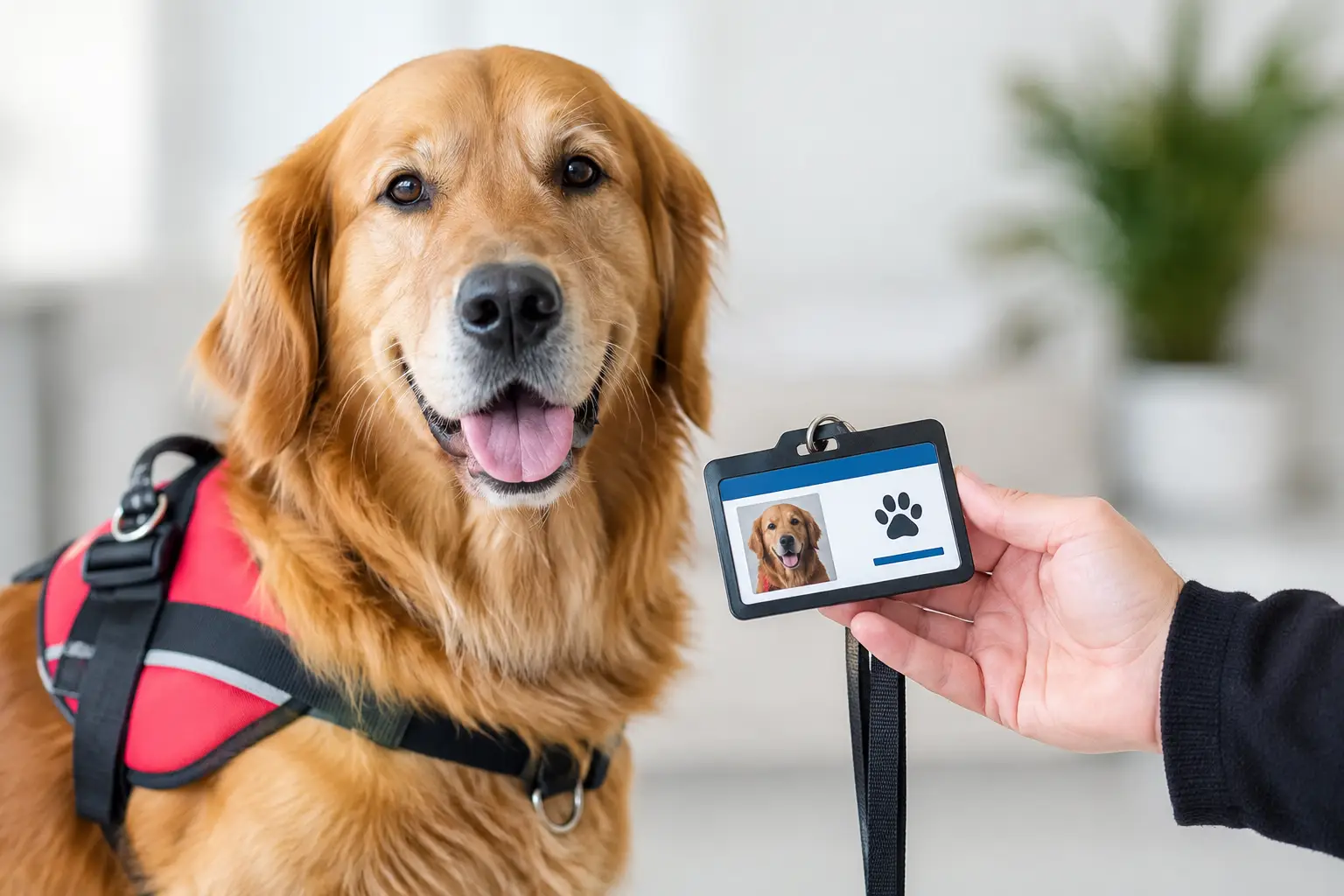
Service Dog ID Card Requirements Explained
A service dog ID card can be a convenient way to keep your dog's identifying information close at hand, but service dog ID card requirements are often misunderstood. Under the Americans with Disabilities Act (ADA), there is no federal requirement to register a service dog, carry an ID card, or purchase a certificate for public access. A card may be useful as a personal reference, but it does not create legal access rights.
For handlers, the practical question is usually not whether an ID card is legally required. It is what information is helpful to organize, when documentation may be requested in a particular setting, and how to carry that information without turning daily errands into a paperwork project.
Are Service Dog ID Cards Required by Law?
No. The ADA does not require service dogs to wear a vest, tag, badge, harness patch, or ID card. It also does not maintain an official national registry or issue federally approved service dog identification.
A service dog is defined by the work it is individually trained to perform for a person with a disability. The work or tasks must be directly related to that person's disability. Examples can include guiding a person who is blind, alerting to sounds, assisting during a medical episode, retrieving needed items, providing mobility support when trained to do so safely, or interrupting certain disability-related behaviors.
This distinction matters because an attractive card or official-looking certificate cannot turn a pet into a service dog. Likewise, a legitimate task-trained service dog does not lose its ADA status because its handler does not have an ID card.
Emotional support animals are different under the ADA. While an emotional support animal may provide meaningful comfort, comfort alone is not a trained disability-related task. Unless the dog has been individually trained to perform qualifying work or tasks, it is not a service dog for ADA public-access purposes.
What Businesses May Ask Instead of Requesting an ID
When it is not obvious that a dog is a service animal, staff in most public-facing businesses may ask only two questions:
1. Is the dog required because of a disability?
2. What work or task has the dog been trained to perform?
They generally may not require a handler to show an ID card, registration certificate, medical records, training papers, or proof of disability. They also may not demand that the dog demonstrate its task.
This does not mean a service dog can go anywhere without expectations. The dog must remain under the handler's control and should be housebroken. A business may ask for a dog to be removed if it is out of control and the handler does not take effective action, or if it is not housebroken. The handler may still return or remain without the dog when appropriate.
An ID card can sometimes make an initial interaction feel more orderly, especially when a handler prefers to have key information readily available. Still, it should be viewed as voluntary identification, not as something a business can lawfully require as a condition of entry.
What a Voluntary Service Dog ID Card Can Include
Because there is no government-mandated card format, private providers may use different designs. The most useful cards focus on simple, accurate identifying details rather than exaggerated legal claims.
A well-organized service dog ID card may include the handler's name, the dog's name, a current photo of the dog, an identification number, and a statement that the dog is task-trained for disability-related assistance. Some cards also include a service dog's date of birth, breed or physical description, and the registry's contact information.
For privacy, think carefully before placing detailed medical information on a card. A handler does not need to disclose a diagnosis to the public. In many situations, a broad description such as “task-trained service dog” is enough for a personal identification reference. The specific task information can remain in the handler's private record unless there is a reason to share it.
Accuracy matters more than appearance. If your address, phone number, dog's photo, or handling information changes, update the record and replace the card if needed. An outdated card can create more confusion than convenience.
When Other Documentation May Matter
ADA public-access rules are not the only rules service dog handlers may encounter. Travel, housing, employment, schools, and state or local programs can involve separate laws and procedures. In these situations, an ID card may be helpful for quick identification, but it may not be the document the organization actually needs.
Air Travel
Airlines follow federal transportation rules that are separate from the ADA's public-accommodation rules. A carrier may require the U.S. Department of Transportation service animal form for a dog traveling in the cabin as a service animal. Depending on the flight length, additional relief-related information may be required.
An ID card does not replace an airline's required form. Before travel, check the airline's current process and submit any required forms by its deadline. Keep your dog's identification materials available as a backup reference, but plan around the carrier's official paperwork.
Housing
Housing requests may be governed by the Fair Housing Act and other housing rules. A housing provider may request reliable disability-related information when a disability or need for the animal is not apparent. The documentation needed depends on the circumstances.
A service dog ID card can help identify the dog, but it is not necessarily proof of a disability-related need for housing accommodation. Avoid assuming one card will satisfy every housing request. Ask the housing provider what information it needs and respond with information appropriate to that request.
Employment, Schools, and State Programs
Workplaces and schools may use their own accommodation processes. Some states, counties, or transit systems may offer voluntary registrations or identification programs. Those programs can be useful locally, but they do not replace federal ADA standards or change a dog's qualifying status.
If an organization asks for documentation, start by identifying which law or policy applies. That simple step can prevent unnecessary disclosure and help you provide the right information rather than every record you have.
A Simple Way to Organize Your Service Dog Record
A voluntary registration package can make day-to-day organization easier by keeping key details in one place. Alpha Service Dog Registration uses an online inquiry followed by an in-home visit or video call to collect the relevant handler and dog information, including the dog's trained disability-related work or tasks. Qualifying registrations can be completed the same day, with an ID card and registration tags provided as convenient identification materials.
Before starting any private registration, gather current information. Have a clear photo of your dog, the dog's basic identifying details, your contact information, and a concise description of the disability-related tasks your dog has been trained to perform. Describe trained work accurately. Do not list tasks the dog is still learning or services the dog provides only through companionship.
It is also wise to keep separate copies of documents that may be needed for specific situations, such as vaccination records, veterinary contact information, airline forms, or housing-related correspondence. A registration record is most helpful when it is part of an organized system, not when it is expected to replace every other document.
Common Mistakes to Avoid
The most common mistake is treating an ID card as legal proof that guarantees entry everywhere. No private card can do that. Public access depends on whether the dog meets the legal definition of a service animal and behaves appropriately in the setting.
Another mistake is oversharing medical details. You can choose to carry an ID card for convenience while keeping your diagnosis and personal health information private. A card should support your preparedness, not pressure you to disclose more than is necessary.
Finally, be cautious of providers that promise “official” federal certification, guaranteed access, or a way to register any dog as a service animal. Federal law does not offer a national certification shortcut. Honest documentation services explain that registration is voluntary and that eligibility depends on genuine, task-specific training.
A clear ID card and organized record can make routine interactions feel less stressful, especially when you are traveling or managing a busy day with your service dog. Carry it because it helps you stay prepared, keep your information current, and have an easy reference when you want one - not because the ADA requires you to prove your partnership with a card.
Comments