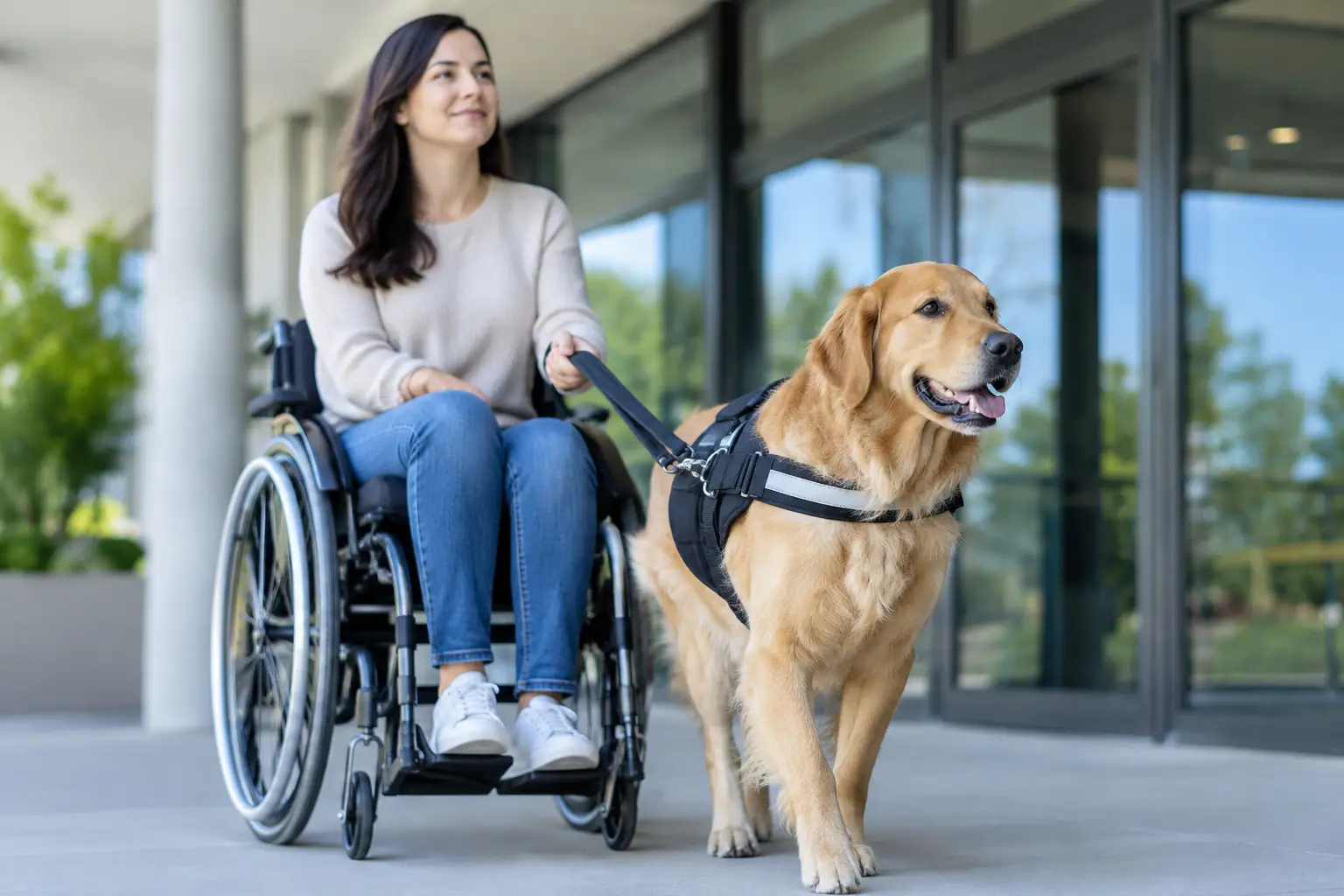
Service Animal Access: What Handlers Should Know
A restaurant host asks about your dog. A hotel employee looks uncertain at check-in. A store manager approaches while you are trying to complete an ordinary errand. These moments can make service animal access feel more complicated than it should be.
For handlers of task-trained service dogs, preparation can make public outings feel more manageable. It also helps to understand the difference between your rights under the Americans with Disabilities Act (ADA), a business’s limited ability to ask questions, and voluntary documentation that may serve as a convenient personal reference.
What Service Animal Access Means Under the ADA
Under the ADA, a service animal is generally a dog that has been individually trained to do work or perform tasks for the benefit of a person with a disability. The work or task must be directly related to the person’s disability.
Examples may include guiding a person who is blind, alerting a person who is deaf, retrieving items, assisting with mobility, interrupting harmful behaviors, reminding a person to take medication, or alerting to an oncoming medical event. The specific task matters. A dog whose presence provides comfort alone, without task-specific training, does not meet the ADA definition of a service animal.
When a dog meets the ADA definition, the handler is generally permitted to bring the dog into places open to the public, including many stores, restaurants, hotels, theaters, and medical offices. Service animal access is not a special favor from a business. It is an accommodation recognized under federal disability law.
That said, access does not mean rules disappear. A service dog must be under the handler’s control and generally must be housebroken. If a dog is out of control and the handler does not take effective action, or if the dog is not housebroken, a business may ask that the animal be removed. The business should still offer the person the opportunity to obtain goods or services without the animal present.
The Two Questions a Business May Ask
When the need for a service dog is not obvious, ADA-covered businesses are limited to two questions:
1. Is the dog required because of a disability?
2. What work or task has the dog been trained to perform?
Employees may not require a handler to disclose a diagnosis, describe the nature of their disability, provide medical records, or demonstrate the dog’s task. They also may not demand a registration certificate, ID card, vest, or other documentation as a condition of entry.
This distinction is useful for handlers to remember. A calm, concise answer to the permitted questions is often enough. For example: “Yes, this is my service dog. He is trained to alert me to a medical condition.” You do not need to volunteer private health details to establish that your dog performs a disability-related task.
Businesses also cannot charge a pet fee for a service dog. If a business normally charges customers for damage they cause, however, it may charge a handler for actual damage caused by the dog under the same policies applied to other customers.
Why Voluntary Documentation Can Still Be Useful
The ADA does not require service dog registration, certification, identification cards, or special equipment. No private registry can grant ADA access rights, determine whether a dog qualifies under the ADA, or replace legitimate task training.
Still, some handlers choose voluntary private documentation for organizational reasons. A consolidated record can keep the handler’s and dog’s information, along with a description of the dog’s trained disability-related work or tasks, in one accessible place. An ID card and registration tags may also provide a convenient identification reference during travel and everyday activities.
The benefit is preparation, not legal authority. Documentation may help a handler quickly identify the dog in a practical setting, but it does not obligate a business to accept paperwork in place of the ADA standard. Likewise, a business cannot require it before allowing a qualifying service dog to enter.
For newer handlers, that boundary can reduce confusion. The goal is not to collect documents in hopes of “proving” a disability to every stranger. The goal is to keep accurate information organized while understanding what the law does and does not require.
Prepare for Public Outings Without Oversharing
Most outings go more smoothly when the dog’s training, behavior, and handler’s preparation work together. This does not mean you need to anticipate every possible interaction. It means having a simple plan when questions arise.
Start with a clear, truthful description of the dog’s trained task. Keep it brief and focused on function rather than diagnosis. If you carry voluntary documentation, treat it as an easy reference rather than something you are required to present.
It also helps to make sure your dog is ready for the setting. Public-access work involves more than knowing an individual task. Your dog should be manageable around people, noise, carts, food, doors, and other everyday distractions. A leash, harness, or tether is generally expected unless it interferes with the dog’s work or the handler’s disability prevents its use. In those situations, the handler must maintain control through voice, signals, or other effective means.
If an employee challenges your access, remain direct and professional. You can explain that the dog is a service dog required because of a disability and identify the trained task. If the discussion continues, ask for a manager. The immediate goal is often to clarify a misunderstanding, not to turn an errand into a lengthy dispute.
Access Rules Can Change by Situation
The ADA is a major part of the service dog access picture, but it is not the only rule that may apply. Housing, air travel, employment, schools, and state or local government services can involve different laws, processes, and documentation expectations.
For example, housing-related requests may involve reasonable accommodation rules rather than the public-access provisions used by restaurants and retail stores. Air travel has its own federal requirements and airline procedures. Employment accommodations are individualized and may involve an interactive process with an employer.
This is why a one-size-fits-all answer can be misleading. A service dog may have ADA public-access rights while a handler still needs to follow separate procedures for a flight, a housing request, or a workplace accommodation. When a situation has higher stakes or a dispute is ongoing, it may be appropriate to review the rules that apply to that setting or seek qualified legal guidance.
Choosing Documentation That Keeps Information Organized
If you decide voluntary registration is useful, look for a provider that is transparent about its purpose. A responsible service should clearly state that registration is not required under the ADA and does not create access rights. It should also distinguish task-trained service dogs from pets and emotional support animals that have not been trained to perform disability-related work or tasks.
The process should be straightforward. Alpha Service Dog Registration offers an online inquiry followed by an in-home visit or video call to collect the information needed for qualifying registrations. The resulting record can include handler and dog details, the dog’s trained work or tasks, an ID card, and registration tags, with same-day completion available after the required information is collected.
Before sharing information with any private provider, consider what is necessary for your own records. Use accurate task descriptions, review the information for errors, and keep personal medical details limited to what is relevant. Organized documentation should support your privacy and preparedness, not require you to disclose more than you are comfortable sharing.
A Practical Standard for Everyday Confidence
The strongest foundation for public access is a legitimately task-trained dog, controlled behavior, and a handler who understands the ADA’s basic rules. A vest may help signal that the dog is working. An ID card may be convenient to carry. Neither is a legal requirement, and neither substitutes for training.
You do not need to be defensive about using a service dog, and you do not need to explain your disability to everyone you meet. Keep your answers accurate, your dog under control, and your key information easy to access. That kind of preparation leaves more room for the things that matter: moving through daily life with greater independence and less unnecessary friction.
Comments