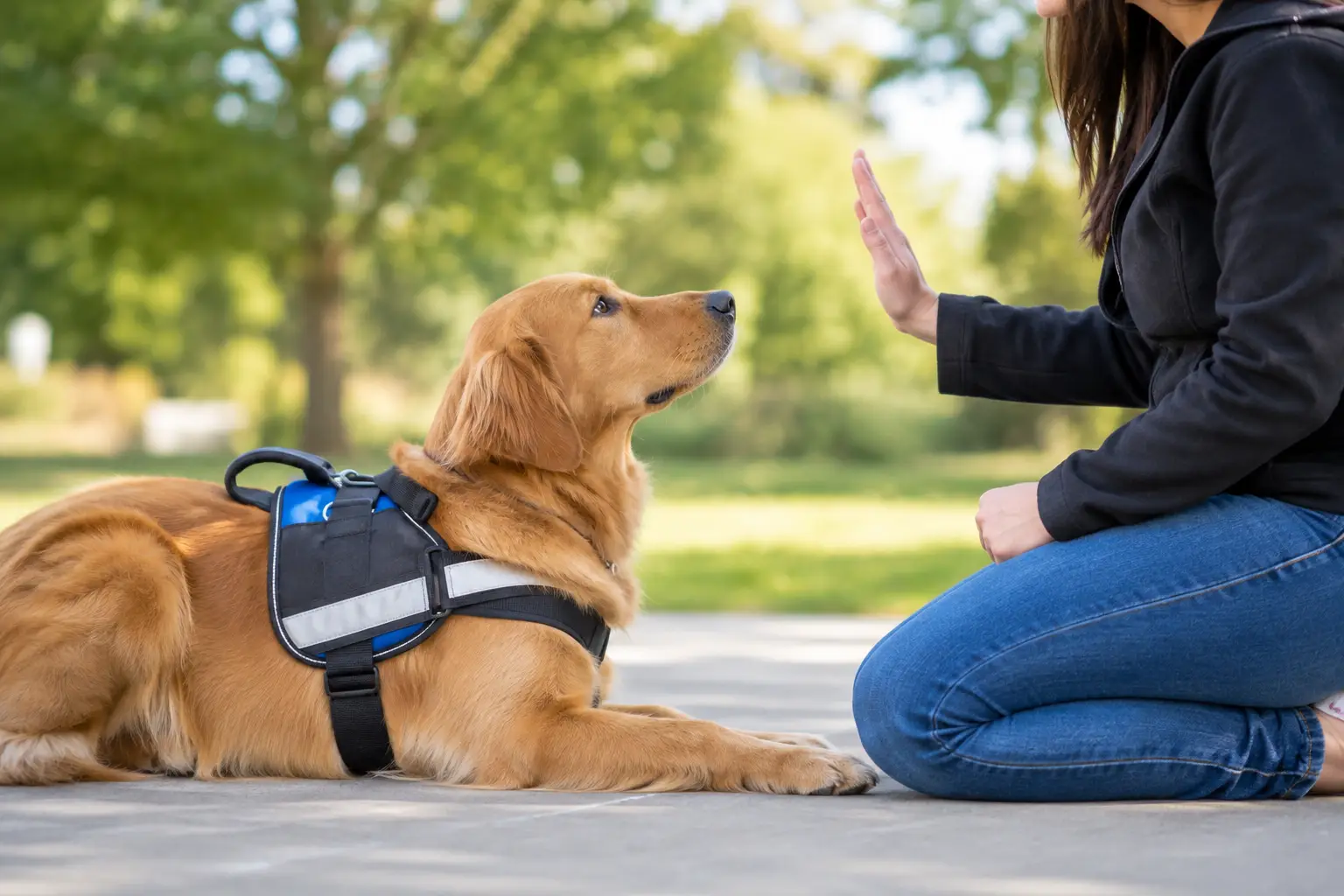
What Service Dog Task Training Really Means
A service dog may wear a vest, stay close in public, and have excellent manners. Those qualities are useful, but they are not what make the dog a service dog. Service dog task training means the dog has been individually trained to perform specific work or tasks that directly help with a handler’s disability.
That distinction matters when you are organizing your dog’s information, discussing your dog’s role, or deciding whether voluntary registration is appropriate. A clear description of trained tasks creates an easy reference for you and helps keep the focus on the work your dog actually performs.
What Counts as Service Dog Task Training?
Under the Americans with Disabilities Act (ADA), a service dog is a dog individually trained to do work or perform tasks for the benefit of a person with a disability. The trained task must be directly related to that person’s disability. The dog’s presence alone, companionship, comfort, or calming effect is not enough without task-specific training.
Tasks look different because disabilities and individual needs look different. A dog trained to guide a handler around obstacles, alert to sounds such as an alarm or doorbell, retrieve dropped items, provide balance support, interrupt self-harming behavior, or respond to a medical change may be performing disability-related work.
The key question is practical: what has the dog been trained to do, on cue or in response to a recognizable need, that helps mitigate the handler’s disability? A task should be describable in clear, factual language. For example, “retrieves medication bag from a designated location” is more specific than “helps when needed.”
Some tasks are trained for a regular verbal cue. Others are trained to respond to a change in the handler’s behavior, posture, breathing, scent, or routine. Either can qualify when the dog has been individually trained to respond in a way that provides disability-related assistance.
Tasks Are Different From Good Behavior
A well-trained service dog should generally be under the handler’s control in public. House training, calm walking, settling quietly, ignoring food, and not jumping on people are valuable skills. They help a dog work safely and appropriately in everyday environments.
Still, public behavior skills are not themselves disability-mitigating tasks. They support the dog’s ability to perform its trained work reliably around distractions. A dog can be polite in public and still be a pet if it has not been trained to perform a disability-related task.
The reverse is also true: a dog may know legitimate tasks but need more practice before working comfortably in busy public settings. Service dog preparation often involves both task training and public-access manners. One does not replace the other.
Examples of Clear Task Descriptions
When documenting a dog’s training, broad statements can create confusion. A concise description should identify the action and the purpose without requiring you to disclose more personal medical detail than you are comfortable sharing.
A handler with a mobility-related disability might document that the dog retrieves a phone after a fall, picks up dropped items, opens an accessible door with a pull strap, or brings a mobility aid from a designated area. A hearing-related task could be alerting the handler to a smoke alarm, timer, name being called, or a person approaching from behind.
For psychiatric disabilities, trained tasks may include interrupting dissociation through a trained nudge, waking a handler from a nightmare, guiding the handler to an exit during a panic episode, or creating space on cue in a crowded setting. For medical disabilities, a dog may alert to a trained medical condition and retrieve supplies, seek another person in the home, or perform another trained response.
Not every task fits neatly into a short label. What matters is that the description remains accurate. Do not list tasks your dog is still learning, performs only occasionally by chance, or has not been trained to do reliably.
How to Build a Useful Task Record
Your service dog’s trained work can change as your needs change and training progresses. Keeping an organized record makes it easier to provide consistent information when you need it, without relying on memory during travel or a busy day.
Start by writing each task in plain language. Include the task itself, the situation or cue that prompts it, and the general purpose it serves. For instance, you might note that your dog “nudges repeatedly when trained signs of dissociation appear to help interrupt the episode.” That is clearer than simply writing “medical alert.”
Then review the list honestly. Separate completed, dependable tasks from skills still in training. This is not about creating the longest possible list. It is about maintaining a reliable record that reflects your dog’s real training.
It can also help to keep basic handler and dog details together, such as the dog’s name, breed or description, date of birth or approximate age, and current vaccination information if you choose. A consolidated file is convenient when you are traveling, changing contact information, or replacing an identification item.
Private Registration and ADA Access Rights
There is no federal ADA registry, certification, identification card, or vest requirement for service dogs. Private service dog registration is voluntary. It does not certify a dog, determine whether a dog is a service animal under the ADA, or grant access rights.
For many handlers, private documentation can still be useful as an organized personal record. It can provide a convenient identification card, tags, and a readily accessible reference containing the dog’s details and trained disability-related tasks. The value is organization and convenience, not legal authority.
Alpha Service Dog Registration uses an online inquiry followed by an in-home visit or video call to collect required information and complete qualifying registrations the same day. Eligibility depends on the dog having task-specific training related to the handler’s disability. Pets and emotional support animals without trained disability-related work or tasks do not qualify as service dogs under this standard.
When entering public places covered by the ADA, businesses generally may ask limited questions when it is not obvious that a dog is a service animal: whether the dog is required because of a disability and what work or task it has been trained to perform. They may not require registration papers as a condition of access. Having a private record can be convenient for your own reference, but it does not change those rules.
A Practical Way to Think About Readiness
Task training is not a single finish line. A dog may learn one task well, then add another as the handler’s needs become clearer. Training may be done by the handler, with a qualified trainer, or through a combination of both. The best approach depends on the task, the dog’s temperament, the handler’s ability to participate in training, and the environments where the dog will work.
Reliability matters more than a dramatic demonstration. A task should work when it is needed, not only in a quiet training session. That may require practice in different rooms, around manageable distractions, and during the real-life circumstances the dog is prepared to address.
At the same time, do not rush a dog into situations that exceed its training. Public work can be demanding, and a dog that appears stressed, distracted, fearful, or unable to remain under control may need additional training or a slower progression. Thoughtful preparation protects both the handler’s independence and the dog’s welfare.
Questions Handlers Often Have
Does my dog need professional task training?
No single training path is required by the ADA. Some handlers train their own dogs, while others work with professional trainers. The standard is whether the dog has been individually trained to perform disability-related work or tasks and can do so reliably.
Can emotional support count as a task?
Emotional support by itself does not meet the ADA definition of a trained task. A dog may qualify when it has been trained to take a specific action that helps with a disability, such as interrupting a panic response or waking a handler from nightmares.
Should I list every behavior my dog knows?
No. Focus on trained disability-related tasks. You may keep separate notes about obedience, public manners, and other skills, but your task record should be factual and specific to the dog’s service work.
A clear task record is not about proving more than the law requires. It is a practical way to stay organized, accurately describe your dog’s training, and carry an easy reference for the work that supports your daily independence.
Comments