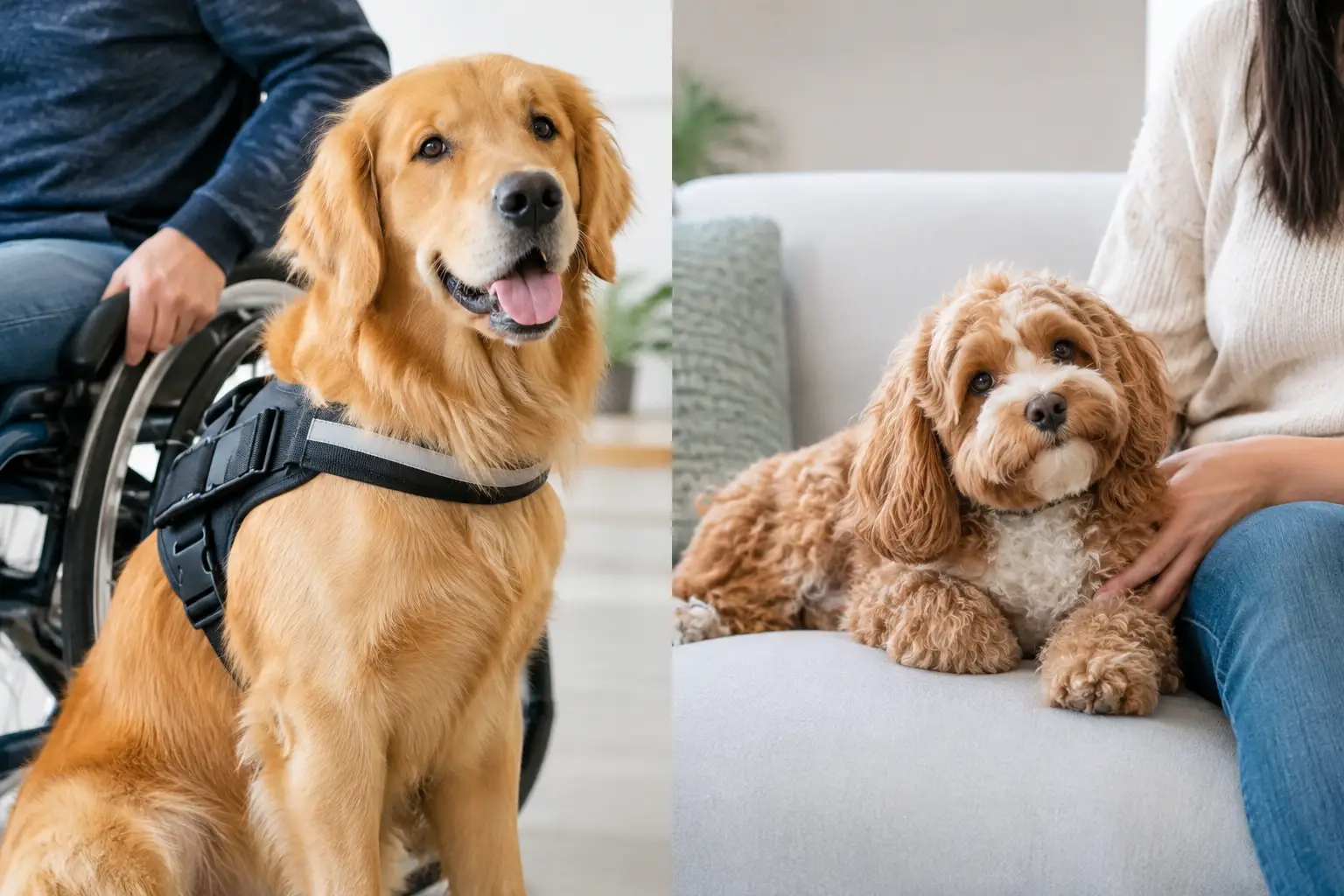
Service Dog Versus ESA: Know the Difference
A dog may provide comfort, companionship, and meaningful support every day. But when you are comparing a service dog versus ESA, the legal distinction comes down to more than how important the dog is to you. It comes down to training, the dog’s role, and the setting where you need accommodations.
Understanding that difference can prevent frustrating conversations at a business, airport, or housing office. It can also help task-trained service dog handlers keep clear, organized information available without relying on claims that a private registration cannot make.
Service Dog Versus ESA: The Core Difference
Under the Americans with Disabilities Act, a service dog is a dog individually trained to do work or perform tasks for a person with a disability. The task must be directly related to that person’s disability. The dog’s training and behavior are central to the definition.
For example, a service dog may retrieve medication, alert to a medical change, guide a person with low vision, provide mobility support when trained to do so safely, interrupt harmful repetitive behaviors, or respond to cues during a psychiatric episode. A psychiatric service dog is still a service dog when it has been individually trained to perform disability-related work or tasks.
An emotional support animal, often called an ESA, provides comfort through its presence. That support can be real and valuable. However, comfort alone is not a trained task under the ADA. An ESA is not a service animal for ADA public-access purposes, even if a healthcare professional has recommended the animal as part of a person’s care.
The practical question is simple: has the dog been individually trained to take a specific action that helps mitigate the handler’s disability? If yes, the dog may meet the ADA definition of a service dog. If the benefit is emotional comfort or companionship without task-specific training, the dog is generally an ESA rather than a service dog.
Public Access Rules Are Not the Same
For many handlers, the biggest difference involves public places. ADA-covered businesses and public accommodations generally must allow a trained service dog to accompany its handler in areas where members of the public may go. This can include stores, restaurants, hotels, medical offices, and other public-facing locations.
Staff may generally ask only two questions when the disability or the need for the dog is not obvious: whether the dog is required because of a disability, and what work or task the dog has been trained to perform. They cannot require a demonstration of the task, request a diagnosis, or demand service dog certification or registration as a condition of access.
An ESA does not receive the same ADA public-access protections. A business may follow its normal pet policy for an emotional support animal. That can be difficult to hear when an animal is an important source of support, but using the correct category protects the credibility of trained service dogs and helps everyone understand the applicable rules.
Public access is also not unlimited for service dogs. A business may ask that a service dog be removed if the dog is out of control and the handler does not take effective action, or if the dog is not housebroken. The person with a disability must still be offered the goods or services without the dog present when possible.
Housing Can Involve Different Standards
Housing is where many people become confused, because the ADA is not the only law that may apply. Under federal fair housing rules, an assistance animal may include an animal that provides disability-related emotional support, as well as a trained service dog. In many housing situations, an ESA may therefore qualify for a reasonable accommodation even though it does not have public-access rights.
Housing providers may be able to request reliable information when a disability or disability-related need for the animal is not readily apparent. What is appropriate depends on the circumstances. They generally should not impose pet fees for an approved assistance animal, although a handler can still be responsible for damage caused by the animal.
There are exceptions and fact-specific situations, including certain small owner-occupied properties and circumstances involving a direct threat or substantial property damage. State and local rules can also add requirements. If a housing question affects a lease, an accommodation request, or a denial, it is wise to review the specific facts carefully rather than assuming that every pet policy has the same outcome.
Travel Rules Require Separate Planning
Air travel is another area where old information still causes problems. Airlines are not required under federal air carrier rules to treat emotional support animals as service animals. Most airlines now handle ESAs under their standard pet policies, which can involve carrier, size, fee, and cabin restrictions.
Trained service dogs may travel with their handlers, subject to applicable airline procedures and federal requirements. Airlines can require certain forms and may address health, safety, and behavior concerns. A service dog should be prepared to remain under control in crowded terminals, security lines, boarding areas, and the aircraft cabin.
For any trip, confirm the carrier’s current requirements before departure. Travel involves more than access rights: it also involves the dog’s comfort, relief needs, space limitations, and ability to work reliably in an unfamiliar setting.
Registration Does Not Create Service Dog Rights
There is no federal ADA registry, certificate, ID card, vest, or tag required for a dog to be a service dog. A dog does not gain public-access rights because it appears in an online database or wears identification. Likewise, a handler does not lose ADA protections simply because they choose not to register their task-trained dog.
That said, some handlers prefer voluntary private documentation as a convenient, organized reference. A record can keep the handler and dog details together with the dog’s trained disability-related work or tasks. An ID card and registration tags may also make it easier to identify the dog in everyday situations, provided they are not presented as legal proof or a substitute for proper training and lawful behavior.
Alpha Service Dog Registration is designed for that administrative purpose. Its private registration process is intended for handlers of task-trained service dogs, not pets or emotional support animals that lack task-specific training. Registration is voluntary and does not grant, determine, or replace ADA access rights.
How to Prepare a Clear Service Dog Record
If your dog is task-trained to assist with a disability, organized information can reduce stress when you are managing appointments, travel, or day-to-day responsibilities. A practical record should accurately reflect your dog’s real training and role.
1. Describe the trained task clearly. Focus on the action the dog takes, not a broad statement such as “provides support.” For example, “alerts to an oncoming medical episode” is more specific than “helps with anxiety.”
2. Keep handler and dog details current. Basic identification details, contact information, and a recent photo can make a personal record easier to use when needed.
3. Maintain strong public behavior. Access questions often arise because of a dog’s conduct, not its paperwork. Reliable obedience, house-training, and calm behavior around people and distractions matter every time you go out.
4. Use documentation appropriately. A voluntary ID card or registration record can be an easy reference, but it is not something a business can require under the ADA. Be prepared to answer the two permitted questions when appropriate instead of treating documentation as legal authority.
Questions Handlers Often Ask
Can my dog be both an ESA and a service dog?
A dog that is individually trained to perform disability-related tasks may be a service dog, even if the handler also receives emotional comfort from the dog. The comfort does not change the dog’s status. The task training is what matters for ADA service dog recognition.
Do I need a doctor’s letter for a service dog?
The ADA does not require a doctor’s letter, certification, or registration for public access with a service dog. Documentation can become relevant in other settings, such as certain housing accommodation requests, but the rules and acceptable information may differ.
Does a service dog have to come from a professional training program?
No federal ADA rule requires a service dog to be trained by a professional program. A handler may train their own dog or work with a trainer. The dog must still be individually trained to perform disability-related work or tasks and must be under control in public.
Clear labels make it easier to advocate for yourself without overstating what any document, vest, or registration can do. When your dog is genuinely task-trained, accurate records and thoughtful preparation can give you a more convenient reference for the places and routines that matter most.
Comments