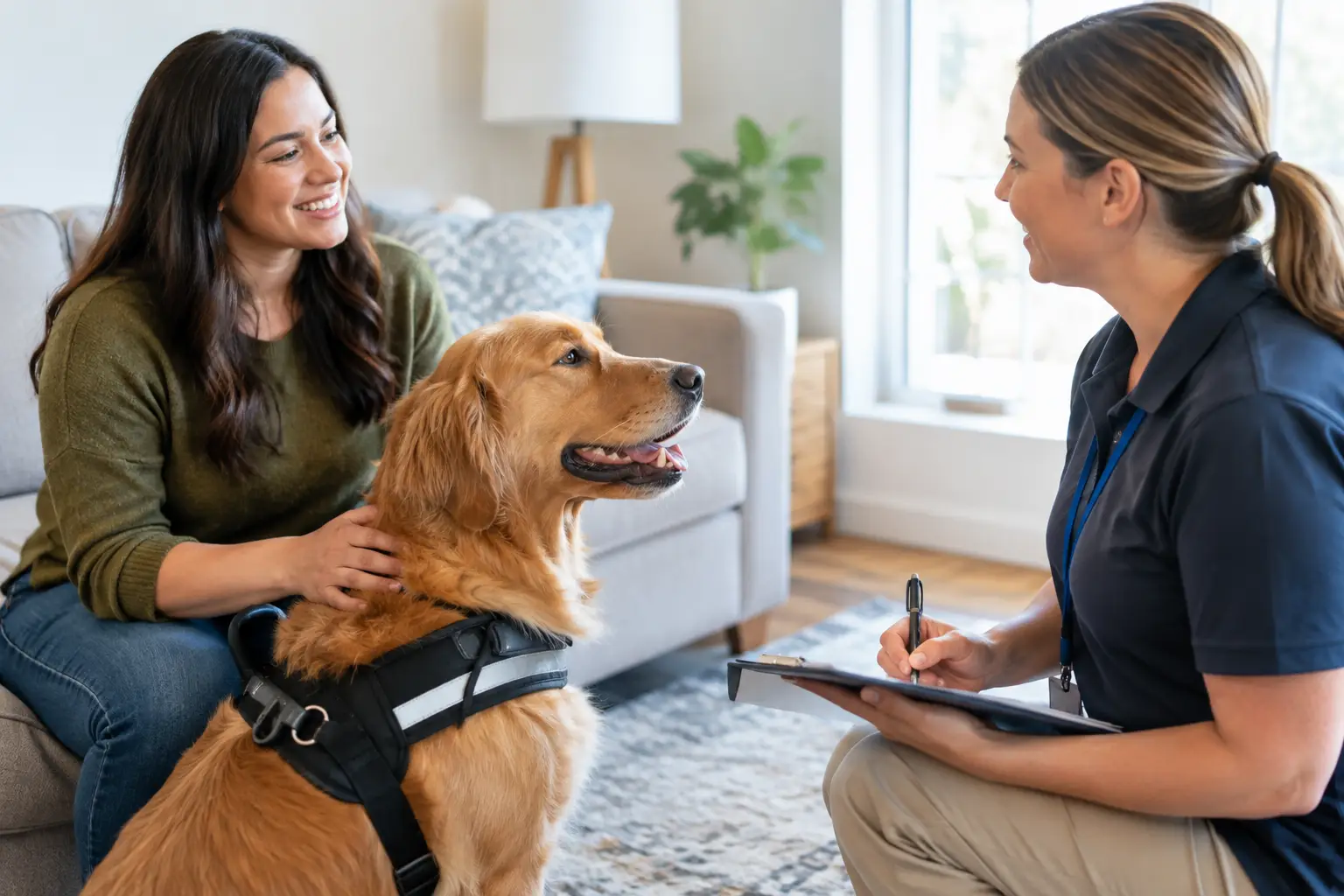
What Happens at a Service Dog Registration Home Visit
A service dog registration home visit can make documentation feel more manageable when you already have enough to coordinate. Rather than adding a long administrative process to your schedule, it gives you an opportunity to organize key handler and dog information from home, with a clear point of contact available to answer process questions.
For handlers with a task-trained service dog, the goal is not to prove a disability to a private registry or obtain legal permission to enter public places. The goal is to create a voluntary, organized record and carry convenient identification materials that can serve as an easy reference during travel and everyday activities.
What a Service Dog Registration Home Visit Is
A home visit is a convenient way to complete the information-gathering portion of a private service dog registration without needing to travel to an office. Depending on your availability and preferences, the review may also be completed by video call. Both options are intended to make the process accessible and straightforward for handlers.
During the appointment, the registration provider collects the details needed for the record. This generally includes handler information, the dog’s identifying information, and a description of the disability-related work or tasks the dog has been individually trained to perform. Once the necessary information has been reviewed, qualifying registrations can be completed the same day.
This process is documentation-focused. It is not a service dog training session, a behavioral evaluation, or a legal certification. A private registration does not determine whether a dog qualifies as a service animal under the Americans with Disabilities Act, and it does not grant public access rights.
Why Handlers Choose a Home Visit
For many handlers, convenience is the practical benefit. A service dog may already be part of a carefully planned daily routine, and arranging transportation, managing symptoms, or visiting another location can take additional energy. Completing the review at home or by video call keeps the administrative portion of registration within a setting you can control.
A home visit also allows time to gather and confirm details without rushing. If you need to check the spelling of a dog’s name, locate a vaccination record for your own files, or think carefully about how to describe trained tasks accurately, you can do so in a familiar environment. The registration record can then consolidate the information you want readily available.
The resulting ID card and registration tags are designed as convenient identification materials. They may help you quickly identify your working dog and keep your registration details organized. They are not a substitute for the dog’s task training, appropriate behavior in public, or a handler’s understanding of applicable rules.
How the Registration Process Works
The process is designed to be direct and manageable. While exact timing can depend on having complete information available, it usually follows these steps:
1. Submit an inquiry. Start by providing the basic information needed to determine whether the registration service is appropriate for your situation.
2. Schedule a home visit or video call. Choose the option that best fits your schedule and comfort level. A video call can be useful when an in-home appointment is not practical.
3. Review handler and dog details. You will provide identifying information for yourself and your dog, along with the dog’s trained disability-related work or tasks.
4. Complete the registration record. For qualifying registrations, the record, ID card, and tags can be processed the same day after the required details have been collected.
Alpha Service Dog Registration uses this format to give handlers a responsive, organized way to complete voluntary documentation without turning the process into a lengthy administrative project.
Preparing for Your Appointment
A few minutes of preparation can help the appointment move efficiently. Have the name you would like used for the handler record, your service dog’s name and basic identifying details, and a clear description of the specific tasks the dog has been trained to perform for your disability.
Describe tasks plainly and accurately. For example, a task might involve retrieving medication, alerting to a medical change, guiding a handler, interrupting a harmful behavior, or providing a trained response to a disability-related need. General companionship, comfort by presence, and emotional support alone are not task-specific work under the ADA definition of a service animal.
You do not need to turn the conversation into a complete medical history. The focus is on the information necessary for the private registration record and on whether the dog is a task-trained service dog. If you are unsure how to describe a task, explain what the dog has been trained to do and how that work relates to your disability.
Voluntary Registration and ADA Access Rights
Clear expectations matter. The ADA does not require service dogs to be registered, certified, or carry identification. There is no official federal service dog registry that gives a dog access rights simply because the dog has an ID card, vest, tag, or registration number.
Instead, ADA access is based on whether the dog has been individually trained to do work or perform tasks for the benefit of a person with a disability. The dog must also be under the handler’s control and behave appropriately in the setting. A voluntary private registry cannot change those standards.
That does not mean organized documentation has no value. Many handlers appreciate having their dog’s details in one place and having convenient identification materials available when traveling or managing everyday routines. It can be a personal organization tool and an easy reference, while remaining separate from the legal question of ADA access.
It also means registration is not intended for every animal. Pets and emotional support animals that have not been individually trained to perform disability-related tasks are not eligible as service dogs through this type of registration. Being direct about that distinction protects the meaning of task-trained service dog work and helps handlers make informed choices.
Common Questions About Home Visit Registration
Does the home visit mean someone is inspecting my home?
No. The purpose of the appointment is to review and collect registration information in a convenient setting. It is not a home inspection, and it is not a test of your living arrangement.
Can I choose a video call instead?
Yes, a video call may be a better fit when you prefer remote completion or when an in-home visit is not practical. The important part is providing the information needed to complete the voluntary registration record.
Will registration guarantee entry into stores, restaurants, or transportation?
No. A private registration does not guarantee access or override the policies that apply in a particular setting. Public access rights under the ADA depend on the dog meeting the legal definition of a service animal and being appropriately controlled.
Is this the same as training or certifying a service dog?
No. Registration documents information about an already task-trained service dog. It does not train the dog, assess its skills, or issue a government-recognized certification.
If a home visit or video call fits your needs, take a moment to organize the information you want on hand. A clear, accurate record can make the administrative side of handling a service dog feel simpler while keeping the focus where it belongs: your dog’s trained work and your independence.
Comments