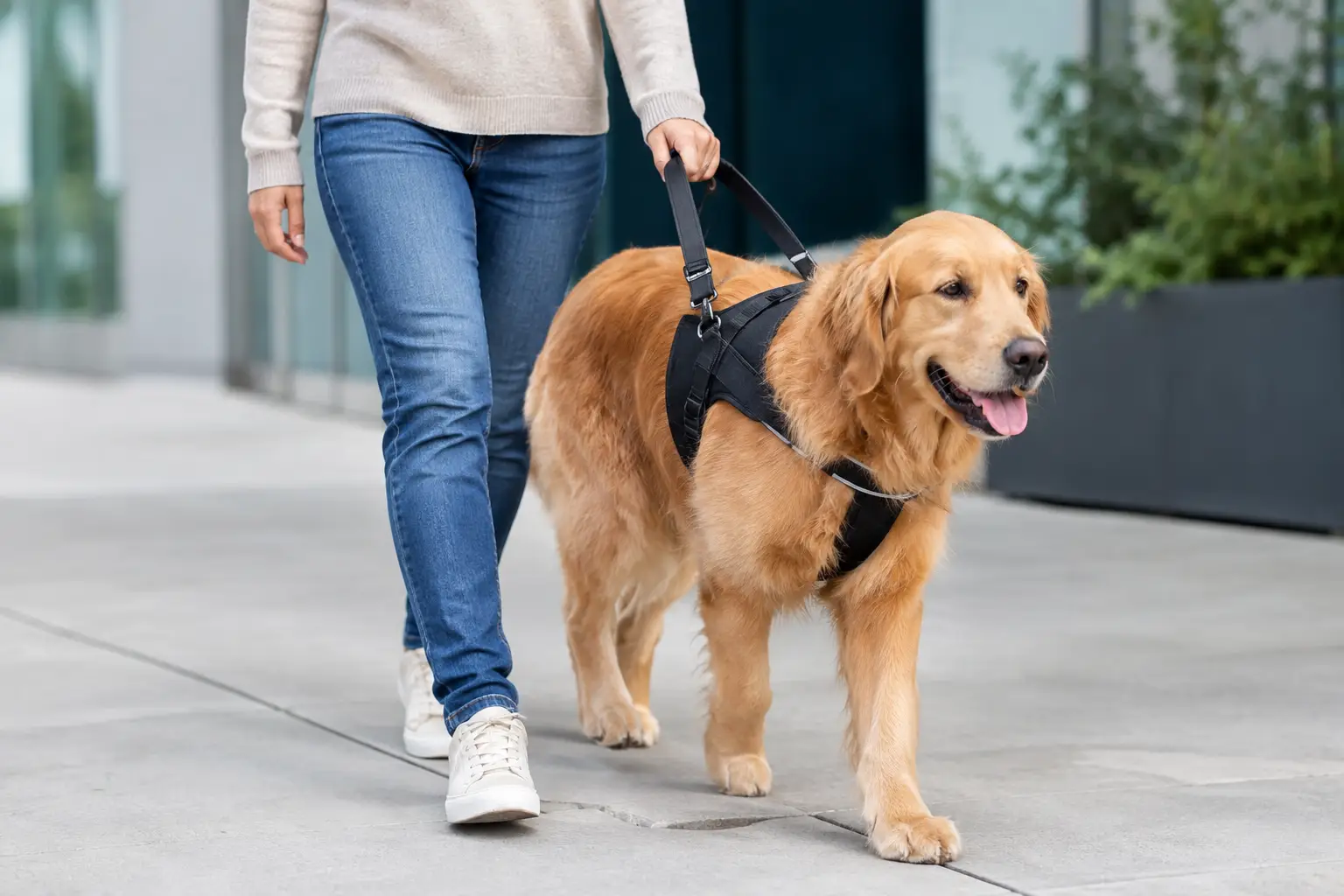
What Qualifies as a Service Dog Under the ADA?
A dog may wear a vest, walk calmly through a store, and be deeply comforting to its owner. Those qualities alone do not answer what qualifies as a service dog. Under the Americans with Disabilities Act, the deciding factor is whether the dog has been individually trained to perform specific work or tasks that help a person with a disability.
That distinction matters because a service dog is not defined by paperwork, breed, a vest, or the place where the dog was trained. It is defined by disability-related task training and the practical help that training provides to the handler.
What Qualifies as a Service Dog?
Under the ADA, a service dog is a dog that is individually trained to do work or perform tasks for the benefit of an individual with a disability. A disability can include a physical, sensory, psychiatric, intellectual, or other mental impairment that substantially limits one or more major life activities.
The task must be directly related to the handler's disability. This is the core standard. A dog trained to bring medication, alert to a seizure, guide a blind handler, interrupt panic-related behaviors, or provide mobility support may qualify when that work is connected to the person's disability.
The ADA recognizes dogs as service animals. In certain circumstances, separately covered ADA rules may require reasonable modifications for trained miniature horses. But a miniature horse is not a service dog, and different factors apply.
A service dog may be professionally trained, owner-trained, or trained with help from a qualified program or trainer. The ADA does not require a handler to use a particular organization. What matters is the dog's actual training and ability to perform needed tasks reliably.
A Task Is More Than Comfort or Companionship
Many dogs help people feel calmer, safer, and more connected. That support can be meaningful. However, comfort by itself is not a trained task under the ADA.
For example, a dog that naturally makes its owner feel less anxious is not automatically a psychiatric service dog. If that dog has been trained to recognize escalating anxiety and respond by nudging, grounding, leading the handler to an exit, or interrupting harmful behavior, the trained response may be a qualifying task when it mitigates the handler's disability.
The difference is not whether the handler loves or depends on the dog. The difference is whether the dog has been trained to take a specific action when needed.
Common service-dog tasks can include:
Guiding a handler who is blind or has low vision around obstacles.
Alerting a handler who is deaf or hard of hearing to alarms, doorbells, or approaching people.
Retrieving medication, a phone, mobility aids, or emergency assistance.
Alerting to changes associated with seizures, blood sugar, or other medical conditions when the dog is trained to do so.
Providing balance support, bracing when appropriately trained, opening doors, or assisting with other mobility-related needs.
Interrupting dissociation, self-harm behaviors, compulsions, nightmares, or panic responses through trained actions.
A task does not need to look dramatic to be legitimate. It needs to be purposeful, trained, and related to the disability. The specific task will naturally vary from one handler to another.
Emotional Support Animals and Service Dogs Are Different
An emotional support animal can provide real comfort and may be part of a person's care plan. Still, emotional support alone does not make an animal a service dog under the ADA.
Emotional support animals are not required to have task-specific training. Service dogs are. That is why an ESA letter, a registration certificate, an ID card, or a vest cannot turn an untrained pet or emotional support animal into a service dog.
This distinction can feel personal, especially when a dog provides essential day-to-day companionship. But clear categories protect access for disabled handlers with task-trained service dogs and help businesses understand their responsibilities. It also helps handlers describe their dog's role accurately when questions arise.
Training and Public Behavior Both Matter
Task training is central, but public behavior is also part of living and traveling successfully with a service dog. A trained service dog should be under the handler's control. In most situations, that means using a leash, tether, or harness unless it interferes with the dog's work or the handler's disability prevents its use.
The dog should also be housebroken and able to behave appropriately in public settings. A business may ask that a service dog leave if the dog is out of control and the handler does not take effective action, or if the dog is not housebroken. The handler must still be offered the opportunity to receive goods or services without the dog present.
This is not a requirement that a service dog be silent, invisible, or perfect at all times. Dogs are living animals, and unexpected situations happen. The practical question is whether the handler can maintain control and whether the dog can work safely and appropriately in the setting.
Service dogs in training are another area where rules can vary. The ADA's public-access protections apply to dogs that are already trained to perform disability-related tasks. State and local laws may provide separate access rules for service dogs in training, so handlers should check requirements where they live or travel.
No Federal Registration or Certification Is Required
There is no federal service-dog registry, certification, license, or mandatory ID card required by the ADA. Businesses generally cannot demand a certificate, request medical records, require a special vest, or insist that a dog demonstrate its task before allowing access.
When a disability or the need for a service dog is not obvious, staff at public-facing businesses may generally ask two limited questions: whether the dog is required because of a disability, and what work or task the dog has been trained to perform. They cannot ask for the handler's diagnosis.
This means registration does not create ADA access rights, and lack of registration does not take those rights away. A private registration is voluntary documentation, not legal certification.
That said, some handlers choose to maintain an organized record of their dog's identifying details and trained disability-related tasks. It can be convenient to keep key information in one place, particularly for everyday travel and planning. It should be used as an easy reference, not as a substitute for training or as proof that an unqualified dog has public-access rights.
For handlers with a task-trained service dog, Alpha Service Dog Registration offers a same-day private documentation process that can include handler and dog details, trained tasks, an ID card, and registration tags. The review may be completed through an in-home visit or video call. This type of voluntary record does not determine ADA eligibility, but it can help a qualified handler stay organized.
Service Dog Access Depends on the Situation
The ADA is a major source of public-access protections, but it is not the only rule that may apply. Housing, air travel, employment, schools, and state or local facilities can involve separate laws, forms, policies, or reasonable-accommodation processes.
For example, housing requests may involve different standards than entering a restaurant or retail store. Air travel has its own federal requirements and carrier procedures. Employers may need to consider both service-dog needs and workplace safety or operational concerns. The answer can depend on the setting, so a general ADA definition should not be treated as the final word for every situation.
A well-prepared handler can make these situations easier to manage by keeping their dog's training information accurate, practicing appropriate public behavior, and understanding the limited questions that may be asked in public places. Documentation may be useful for personal organization, but honest communication and reliable task training remain the foundation.
A Simple Way to Assess Your Dog's Role
If you are unsure whether your dog qualifies, start with three practical questions. Do you have a disability as defined by applicable law? Has your dog been individually trained to perform one or more specific actions? Are those actions directly related to helping with your disability?
If the answer to each question is yes, your dog may meet the ADA definition of a service dog. If the dog mainly provides comfort, companionship, or a sense of security without trained disability-related tasks, the dog does not qualify as a service dog under the ADA.
When the answer is not clear, take time to identify the exact task, when the dog performs it, and how it reduces the effects of the disability. That exercise can bring useful clarity long before a hotel check-in, a medical appointment, or a busy travel day requires you to explain your dog's role.
Comments